Looks like Korean Buddhists had a chance to talk with the Dalai Lama while he was in Japan. Story here:
http://www.buddhistchannel.tv/index.php?id=44,9310,0,0,1,0
Monday, June 28, 2010

DVD Spotlight - Cloud Path: Journey of a Wandering Monk

A new edition to the blog, DVD Spotlight, will highlight a particular film that blog readers and sangha members may be interested in viewing. Expect a link to a new film each week, either on Sunday or Monday. The blog will contain a brief summary of the film, relevant links and possible reviews.
The first film to be highlighted is Cloud Path: Journey of a Wandering Monk
Cloud Path, Journey of a Wandering Monk is a documentary about a distinguished Buddhist monk. This was originally a locally produced TV program that had been aired in Korea and was selected by the Korea Foundation as an outstanding work for introducing Korean culture abroad. The original content has been dubbed into English. The documentary records the activities of Paul Muenzen (Buddhist name: Hyongak 玄覺), a Harvard University graduate who became a monk, as he learns the Manhaeng (萬行), experiences of the secular world. Along with its highly acclaimed cinematography, various aspects of Korea's rich traditional culture are seen through the eyes of this American monk.
Ven. Hyon Gak is a personal favorite of mine and is a great public speaker and Dharma instructor. He gave two lectures that are available online for viewing or downloading in MP3 format. The lectures are entitled "Bodhi-Dharma to America" and "Diamond Sutra" lectures.
The videos are available here.
The MP3 audio only versions can be downloaded here.
In Hapjang,
-T'ajin
Dharma Talk Summary
June 27, 2010
Talk Given by Rev. Hye Kyong
9 Minutes
Dhammapada Reading: Chapter 2 "Diligence"
Diligence is the path to the deathless. Negligence is the path of death. The diligent do not die. Those who are negligent are as the dead.
Understanding this distinctly, those who are skilled in diligence rejoice in diligence, delighting in the pasture of the noble ones.
For the person of energy, thoughtfulness, pure conduct, considerate action, restraint, wholesome living, and diligence, glory increases.
With energy, diligence, restraint, and control, the wise person should make an island which no flood can overflow.
The other day I was at work and I had a customer who requested a MSDS (Material Safety Data Sheet) on a product. I was reading through it, about chemical make up, percentage of chemicals, possible hazards, and what to do with the chemicals. It's about 7 pages long and I don't usually read through the whole thing, but when I got to the end of it something caught my eye. It said,
" Kindness is the oil that takes the friction out of life."
And I thought, what a weird thing to have on a MSDS! But I started thinking about it and that's really true. It just struck me as really odd. If you can be kind to people, half of your problems are taken care of right there. Be nice to everyone. That's what it all boils down to.
I got a little to story to tell you but before I do I need to tell you about my wife so that you don't get the wrong picture. My wife is a wonderful person, She's very compassionate, she works in the healthcare industry, she's a way better Buddhist than I could ever aspire to be. She really puts everything into practice and she really is a great person. But she has one little thing. She's part Irish.
Last week, I was thinking about spaghetti all week. Thursday came and we decided to go out to eat. We started walking down Woodward and this has probably happened to everyone when you're walking through the crosswalk and a car comes over and blocks the walkway so you have to go behind the car.
Well sure enough, after walking a couple of blocks this happens. My wife panics and says, "That is so rude and makes me mad!"
A couple of more blocks and it happens again. "Oh man, that person could of hit us! That is so rude!" My wife asked me, "Doesn't that make you mad?" Well, yeah, I can let it make me mad and I can carry it with me or I could just let it go. After all, there isn't much I could do about it other than run over there with my cell phone, take a picture of his license plate and mail it to the police. But I said, I rather just let it go at this point. That's what we do in life, we make choices. The smallest decision can turn into a real big thing.
Many of you know how I like those Zen parables, here's another one I'd like to share:
"A man traveling across a field encountered a tiger. He fled, the tiger after him. Coming to a ledge, he caught hold of the root of a wild vine and swung himself down over the edge. The tiger sniffed at him from above. Trembling, the man looked down to where, far below, another tiger was waiting to eat him. Only the vine sustained him. Two mice, one white and one black, little by little started to gnaw away the vine. The man saw a luscious strawberry near him. Grasping the vine with one hand, he plucked the strawberry with the other. How sweet it tasted!"
You're going to wind up in the same place anyway, you might as well enjoy what you have. Let the little stuff go. Your life is the Dharma, the Dharma is your life. What you do with it and how you act is up to you. Sometimes impermanence is a wonderful thing. It lets us let go of our anger, and put these problems and little things behind us. Impermanence surrounds us, it's not good or bad, it's just what is.
Wednesday, June 23, 2010
Dharma Talk Summary
June 20, 2010
Talk Given by Rev. Hye Kyong
10 Minutes
Dhammapada Reading: Chapter 6 "The Wise"
A wise person who would admonish you for your faults is a good person to follow.
Following such a one is like following a guide to a buried treasure.
Simply being with that person is helpful to you.
Today is Father's Day. How many people here are fathers? How many people have fathers?I think that fathers are overrated. I think fathers got a day just because mothers had one.
It's kinda weird with fathers. I was watching fathers in my neighborhood this week while thinking what I was going to talk about. I started watching the fathers, some pushing strollers and know that he wouldn't be there if the mother wasn't. Nothing really tells men how to be fathers, there's no instruction manual. We don't really know what to do all that much. I guess our function really is to keep our kids from growing up to be assholes. That's pretty tough to do in some cases.
My parents had me pretty late in life. I think my mom was about 40 something so you can imagine that they planned for me. My older siblings pretty much sucked the life out of my parents by then. They were shells of people.
I didn't get to know my dad as well as I would've liked to and I didn't think to ask the questions I want to know now. There were a couple of things he did teach me though, and they still stuck with me today. My father said he was an atheist but I wonder what if the Buddha-Dharma was available to him back then. One of the things he taught me was, "Do unto others as you want done to you."
I found this reading, "Everyone fears being hurt, all of us fear death. Knowing this, see others as yourself and cause no harm. Everyone fears being hurt, life is dear to all, knowing this, see others as yourself and cause no harm."
I thought, Dad was a bodhisattva and didn't even know it.
As most of you know I've been a musician all my life and started playing at a pretty early age, around 12. I would be sitting around playing guitar and my dad would come in and ask, "Can you play Windchester Cathedral?" I'd say, "no." Then he would say, "You can't play nothing if you can't play Windchester Cathedral!" Secretly I did learn it but I never told him.
I came across this other reading,
"Who are you?" asked the Master.
"I am a soldier for the great emperor's personal guard."
"Nonsense!" said the Master. "What kind of emperor would have you around him? To me, you look like a beggar." At this, the soldier started to rattle his sword in anger. "Ohhhhhh.... you have a sword!" said the Master. The solider could not hold himself back, he drew his sword and threatened the Master. At this the Master said, "Now you know half the answer, you are opening the gates of Hell." The solider drew back and put away his sword and bowed. "Now you know the other, you have opened the gates to Heaven."
So I guess learning Windchester Cathedral is like opening the gates of Hell for me, but nonetheless I guess I learned the answer.
The thing I'd like you to take away from this talk you need to realize what you have available now in the Dharma is something you need to appreciate. Do it now, don't wait until it's too late. I often think I wish I would've found out about this a lot sooner then I did. Make an effort, do it now. Don't waste your life.
Happy Father's Day!
Tuesday, June 8, 2010
Dharma Talk: Judging Others
June 6th, 2010: Rev. Hae Kyong
The Dharma talk began with two readings: Chapter 14 from the Dhamapada "The Buddha" and "See the moon forget the pointing finger" from "Swampland Flowers: The Letters and Lectures of Zen Master TA HUI"
"As many of you know I have daughters, and to tell this story I am going to change their names.
I am riding in the car with my wife and daughter "X". Daughter "X" begins complain about Daughter "Y’s" boyfriend choices. Daughter "X" says Daughter "Y" shouldn’t go out with said boyfriend because he has no ambition he doesn’t want to go to college and make something of himself. He’s just a loser she said.
At this point I interject: It’s not nice to judge others maybe he’s happy with his life the way it is. Besides (to steal a line from Venerable Hae Doh) it’s easy to see the twig in someone else’s eye while missing the log in your own.
This conversation reminded me of a conversation I had with a store owner Ernie of Ernie’s Market who by the way makes the best sandwiches in the area 8500 Capital in Oak Park. Go there you won’t be sorry. I use to live down the block from his store and sometimes went there on Saturday to get an ice cold 40oz Miller High Life the "Champagne of Beers" from his old fashion walk in cooler.
Ernie is a true Bodhisattva who loves everyone. But one day I walked in to find him truly miffed by a customer he had just encountered. I don’t remember all the details because it was 20 years ago. But the gist of it was the customer (I believe he was a city worker) told Ernie that "yes his job might suck, but at least he made more money than Ernie". Ernie’s comment to me was “when did money become the yard stick by which we measure a man?”
More recently I was speaking with a co-worker who was telling me that her brother-in-law was very successful (meaning he had a lot of money), then continued on to tell me how he was a big jerk and treated her sister like crap. So how is that successful?
We all have our own criteria with which we judge success and failure. We judge others with these criteria in order to boost our own ego. We try to make ourselves feel better by casting dispersions on others. We all do it myself included.
I’m always up here telling you all to practice patience to avoid anger. Yet just last week I exploded in anger because I judged a relatives behavior as unacceptable. I couldn’t contain my anger and try as I might I’m still carrying the anger with me. The Buddha said getting angry at someone is like picking up a piece of hot coal with the intent of throwing it at someone else. You will also be burnt. I can definitely attest to that fact.
The reality is when you get old (like Ven. Hae Doh) you can look back on your life and realize that in your life and everyone else’s as well there is a time when we were winners and there was a time when we were losers there was a time we did the right thing and a the times we still suffer because we did the wrong thing. Some how those wrong things seem to jump out like a sore thumb.
Do the best you can and hope you don’t get judged to harshly for it later.
The Dharma talk began with two readings: Chapter 14 from the Dhamapada "The Buddha" and "See the moon forget the pointing finger" from "Swampland Flowers: The Letters and Lectures of Zen Master TA HUI"
"As many of you know I have daughters, and to tell this story I am going to change their names.
I am riding in the car with my wife and daughter "X". Daughter "X" begins complain about Daughter "Y’s" boyfriend choices. Daughter "X" says Daughter "Y" shouldn’t go out with said boyfriend because he has no ambition he doesn’t want to go to college and make something of himself. He’s just a loser she said.
At this point I interject: It’s not nice to judge others maybe he’s happy with his life the way it is. Besides (to steal a line from Venerable Hae Doh) it’s easy to see the twig in someone else’s eye while missing the log in your own.
This conversation reminded me of a conversation I had with a store owner Ernie of Ernie’s Market who by the way makes the best sandwiches in the area 8500 Capital in Oak Park. Go there you won’t be sorry. I use to live down the block from his store and sometimes went there on Saturday to get an ice cold 40oz Miller High Life the "Champagne of Beers" from his old fashion walk in cooler.
Ernie is a true Bodhisattva who loves everyone. But one day I walked in to find him truly miffed by a customer he had just encountered. I don’t remember all the details because it was 20 years ago. But the gist of it was the customer (I believe he was a city worker) told Ernie that "yes his job might suck, but at least he made more money than Ernie". Ernie’s comment to me was “when did money become the yard stick by which we measure a man?”
More recently I was speaking with a co-worker who was telling me that her brother-in-law was very successful (meaning he had a lot of money), then continued on to tell me how he was a big jerk and treated her sister like crap. So how is that successful?
We all have our own criteria with which we judge success and failure. We judge others with these criteria in order to boost our own ego. We try to make ourselves feel better by casting dispersions on others. We all do it myself included.
I’m always up here telling you all to practice patience to avoid anger. Yet just last week I exploded in anger because I judged a relatives behavior as unacceptable. I couldn’t contain my anger and try as I might I’m still carrying the anger with me. The Buddha said getting angry at someone is like picking up a piece of hot coal with the intent of throwing it at someone else. You will also be burnt. I can definitely attest to that fact.
The reality is when you get old (like Ven. Hae Doh) you can look back on your life and realize that in your life and everyone else’s as well there is a time when we were winners and there was a time when we were losers there was a time we did the right thing and a the times we still suffer because we did the wrong thing. Some how those wrong things seem to jump out like a sore thumb.
Do the best you can and hope you don’t get judged to harshly for it later.
Monday, May 31, 2010
Dharma Talk Summary
May 30, 2010
Talk Given by Rev. Hye Kyong
9 Minutes
Dhammapada Reading: Chapter 20 "The Path"
The spiritual path is the eightfold path,
the truths are the four noble truths.
This is the path for purity of vision,
following it protects you from temptation,
following this path leads to the end of suffering.
This truth was declared once Buddha learned
how to pull the arrow out of suffering.
You must do your own work,
a Buddha can only guide you.
You know what I like? You ever see those things with the fan and the tube and looks like a person dancing? Every time I see those things they crack me up. I really like them. They don't have anything to do with my talk but I was just thinking about those things.
The other morning, I woke up and looked at myself and thought I looked like crap. I walked back and saw a picture of myself with my mom when I was 31 and looked pretty good.
Later on, my wife and I were driving and saw a couple pushing a baby carriage. The guy had gray hair and the woman did not. It got us talking about how when we get older we noticed how the media puts all this attention on youth.
My wife asked me "If you could go back would you want to go back?" I thought about it for a few minutes but said "no." It got me to thinking, when you're old, like Hae Doh (everyone erupts in laughter), living in the moment is easier, when you look out in your future there isn't much there. When you're young, you're living in the future all the time, thinking about I'll be this and I'll be that. But when you do that, a lot of everything else escapes. The moment escapes. Here's a little quote ---
"Most of us aren't willing to face the reality of impermanence and death.
That's because we forget our lives are transitory. We quarrel with each other as if we're going to live forever. But if we face the fact of death our quarrels will come to an end. We will realize the folly of fighting, when we ourselves are doomed to die. Excited by emotions, our thoughts are clouded. We do not see the truth about life. When we see the truth however, we become free of emotion."
Be happy now. Every moment you had in your life is leading to this moment. Going back sounds nice in your head, but you wouldn't be who you are today, if every moment, good or bad, didn't lead you here. You can make the most of your life now. But how can you do that? Take something you love, something you're passionate about, take that same passion and apply it to everything in your life.
A lot of times we lament on stuff we used to have. This job I had before, the girlfriend I had 10 years ago is hotter than the one I have now. We have all had the situations but the key is to make today the best you can. Forget about that stuff. Apply your efforts to today. That's Viriya Paramita (joyous effort).
I got this other quote that I thought was really good. ---
"The triple world originates from the discrimination of unrealities and where discrimination takes place there is duality, and the notion of permanency and impermanency. But the Tathagatas do not rise from this discrimination of unrealities. Thus, as long as there is discrimination, there will be the notion of permanency and impermanency. When discrimination is done away with, noble wisdom, which is based on the significance of solitude will be established."
Back to those dancing things. I was asking people about them to see if I was strange that I was finding so much happiness in them. People told me I could buy one. I thought about it for a while but I started thinking that if I had one that it wouldn't be cool anymore. The cool thing is that I can see it and be happy but if I had one all the time I would get sick of it. The thing is you have to appreciate it and let it go.
Thursday, May 27, 2010
Vesakha Puja Recap
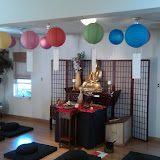
This past Sunday the Muddy Water Zen sangha and friends celebrated Vesakha Puja (Buddha's Birthday) after a special morning service which included a "bathing of baby Buddha" ceremony, in which everyone was invited to wash the baby Buddha statue and promise something to themselves.
The temple was also decorated with colorful paper lotus lanterns which were donated by individuals and families. The lanterns also have personal wishes attached to them that will remain hanging in the temple for 30 days and then the wishes will be burned to send them out into the Universe.
After the morning service many of us stayed to share a potluck lunch that included a lot of delicious food and snacks. Some of the pictures taken at our potluck party are displayed below. Be sure to check them out!
Dharma Talk Summary
May 23, 2010
Talk Given by Hae Doh Sunim
15 Minutes
Dhammapada Reading : Chapter 14 “The Awakened”
The person whose victory is not diminished,
Whose victory no one in the world can touch,
That one is awakened, of limitless sphere, trackless.
By what path would you lead that one?
The person for whom there is
No ensnaring, entangling craving
To lead him anywhere at all,
That one is awakened, of limitless sphere, trackless.
By what path would you lead that one?
They are wise who pursue meditation,
Delighting in the calm of renunciation.
Even the radiant ones long for those
Who are fully awakened, the mindful.
Difficult is the attainment of a human birth.
Difficult is the life of mortals.
Difficult is the hearing of the good way.
Difficult is the appearance of those who have awakened.
The refraining from all that is harmful,
The undertaking of what is skillful,
The cleansing of one’s mind---
This is the teaching of the awakened.
Enduring patience is the highest austerity. (Emphasized in talk)
The awakened ones say that unbinding is supreme.
A person who injures has certainly not begun to practice;
One who harms others is not a seeker.
Not abusing, not harming,
Restraint in line with the discipline,
Moderation in eating and seclusion in dwelling,
Exertion in meditation as well---
This is the teaching of the awakened.
The Dhammapada: Verses on The Way Glenn Wallis
Hae Doh Sumin began the Dharma talk by posing a question to the women in the audience asking them to imagine what it would be like to be 40 years old, pregnant for the first time, while sharing a husband with your sister. This was the predicament that Queen Maya, mother of the Buddha, found herself in. Queen Maya was probably scared and rightly so, after dying only a week after giving birth to Siddhartha. His stepmother, who later became a major supporter of the sangha and one of the first female monks, raised Young Siddhartha.
Hae Doh Sunim next told a personal story about his surprising and somewhat unexpected pregnancy with his former wife, Myo Sung. While they were both overwhelmed and amazed by nature and the possibilities they were warned by their doctor that the baby could be possibly born with Down syndrome since they were both older. They both agreed to accept whatever they got, healthy or otherwise and would not abort. In Buddhism, life begins at conception.
Next, he told the story of his experience adopting a baby with his first wife 29 years ago. He told how it was a 2 ½ year process and the trials they were put through before being allowed to adopt. Their only request was that the baby is under 1 year old and they did not give any preference for race or gender, accepting what they were given.
Hae Doh Sunim recently received an email from a man asking him to introduce himself to the man’s children to teach them about meditation after they tried several different places and found walking meditation and chanting to be “silly” and “laughable”. He basically wanted to design a religion that fit his lifestyle and pick and choose which parts he deemed suitable.
For many of us, Buddhism is not our birth religion but our adopted religion. Like adopting children or having them naturally, there should be no different feelings. When you adopt a religion you should adopt everything and should try to live by the “vinaya” (rules). In Buddhism there exist the Tripitaka (three baskets). The Vinaya Pitaka are a set of monastic rules, but still rules all Buddhist can try to follow, the Sutta Pitaka, which are the Sutras and teachings, and the Abhidhamma Pitaka, the philosophical underpinnings.
Luke wrote Jesus saying; “From everyone who has been given much, much more will be demanded and from the one who has been entrusted with much, even much more will be asked.”
“If you’re going to call yourself something; Buddhist, Christian, Muslim, Hindu, Jewish, Wiccan, it doesn’t matter, as long as you manifest it and commit whole heartedly.”
“Today is Buddha’s Birthday. Buddhism is all about dying to the self, dying to your ego, letting go of small mind and becoming part of big mind. Are you willing to die? Like Queen Maya died? Are you willing to die? Are you willing to give it up for liberation? If you are, I would also wish you not only a happy birthday, but also a happy death day.”
Sunday, May 24, 2009
The Launch of the Muddy Water Zen Blog
Hello Sangha members,
We started this blog to communicate more frequently to you about things that are going on at Muddy Water Zen, stories about Buddhism and anything else that crosses our minds that we think you may be interested in. Feel free to respond in the comments section to each post. Both myself (Haedoh Sunim) and HaeKyong Sunim will be creating posts here over time.
Thank you for visiting and check back!
Haedoh Sunim
We started this blog to communicate more frequently to you about things that are going on at Muddy Water Zen, stories about Buddhism and anything else that crosses our minds that we think you may be interested in. Feel free to respond in the comments section to each post. Both myself (Haedoh Sunim) and HaeKyong Sunim will be creating posts here over time.
Thank you for visiting and check back!
Haedoh Sunim
Subscribe to:
Posts (Atom)